
Bellevue Previous Resident Sources
A backward address search crosses several eras. The current parcel card supplies the owner, situs address, parcel number, legal description, and recent sale clue. Deeds then identify title transfers. Directories and census schedules add household names, while permits, property cards, and newspapers explain changes that deeds do not show.
| Source | Years It Covers | Where Held | What It Shows |
|---|---|---|---|
| Landmark index | Generally 1976-present | King County Recorder | Parties, document types, dates, numbers, some images |
| Recorded-document images | Most from August 1, 1991 | Landmark | Deeds, liens, easements, mortgages, and plats |
| Archives documents | 1853-1991 microfilm and historic indexes | King County Archives | Older grantor, grantee, name, and date trail |
| Parcel sales and excise indexes | 1973-1981 and 1961-1997 | King County Archives | Parcel or legal-description transfer clues |
| Regional city directories | 1964-65, 1966, 1972, 1982 verified | Regional libraries | Names and sometimes address-order entries |
| Real-property cards | 1937-1972 | Puget Sound Regional Archives | Assessment, photo, sketch, parcel, ownership clues |
| Bellevue newspapers | 1935-2003 across three main titles | Bellevue Library microfilm | Notices, obituaries, local addresses, and events |
Begin with the modern parcel even when the goal is much older. Its legal description is the bridge into records that were never indexed by street. For a mid-century household, combine the deed trail with a verified directory year and newspaper film. For earlier work, plan on an archive or library handoff.
Trace Bellevue Owners Backward
The King County chain starts with Parcel Viewer and the Assessor's eReal card. Record the current owner, situs and mailing addresses, parcel number, plat or lot, legal description, last sale date, and any recording number. A situs address is the physical property site; the mailing address may lead elsewhere and must not be treated as proof of who lives there.
- Find the exact address in Parcel Viewer and open its eReal card. Copy the parcel and legal description.
- Use the recording number or current owner in Landmark to locate the purchase deed.
- Read the deed's grantor, grantee, recording date, consideration, legal description, and prior reference.
- Search the seller as a prior grantee in an earlier date window. Repeat with trusts, estates, or each named party when needed.
- At every transfer, confirm the same legal description. Move to Archives microfilm when the online image trail ends.
The Landmark Records Search offers name, document type, book and page, recording number and date, parcel ID, and legal-description modes.
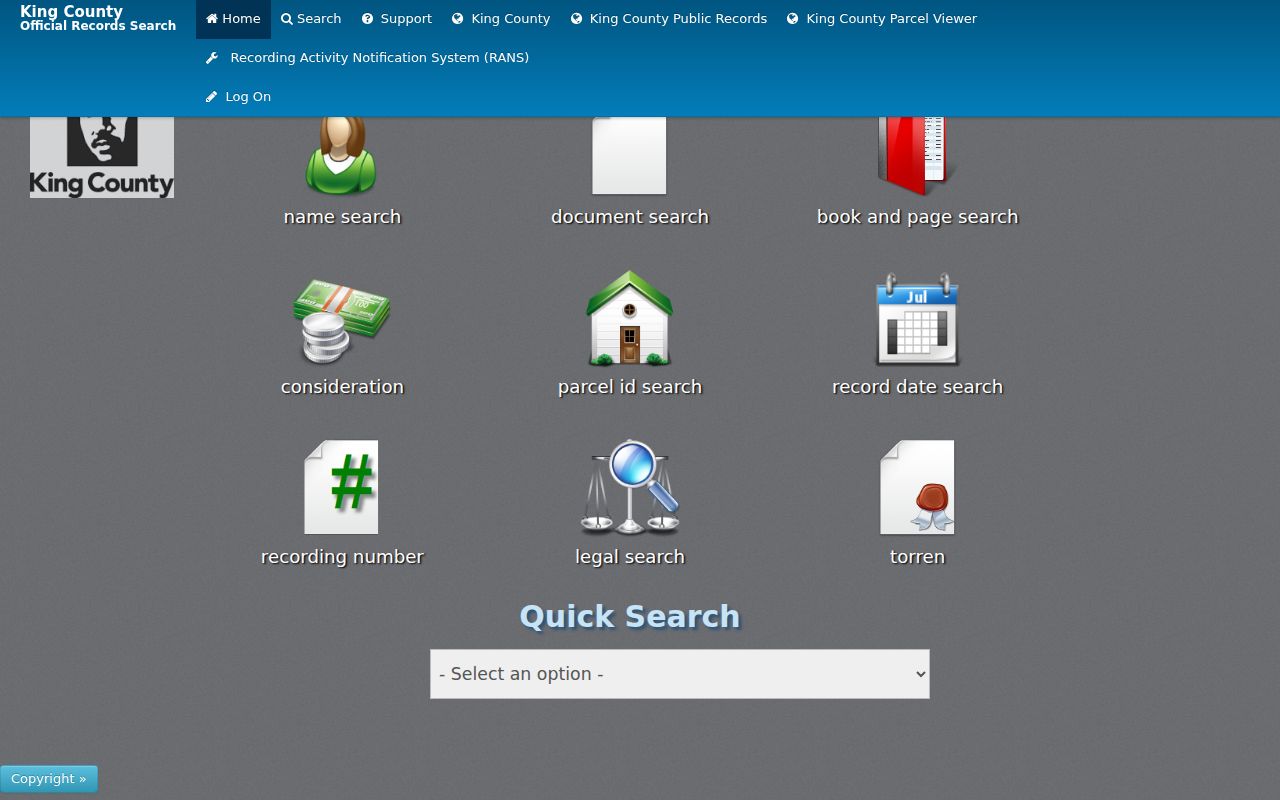
Names alone can lead to the wrong parcel. Keep the recording number and legal text beside each person so the chain remains tied to one Bellevue property.
- Grantor and grantee
- The grantor gives or conveys an interest; the grantee receives it.
- Chain of title
- The linked sequence of transfers for the same property.
- Legal description
- The plat, lot, block, unit, survey, or metes-and-bounds text that identifies land.
- Criss-cross directory
- A directory arranged by address or telephone number rather than surname.
Bellevue Records Cross the 1991 Line
August 1, 1991 is the practical online-image cutoff. King County says most recorded documents dated on or after that day have images online. Landmark's index generally reaches to 1976, but an index hit is not the same as a viewable deed. Earlier recorded documents are generally on microfilm at King County Archives.
The offline handoff has named tools. Archives recorded-document material reaches back to 1853. Historical indexes use party name and date rather than a street address. Parcel sales histories cover 1973-1981, and excise-tax indexes cover 1961-1997 by legal description. Those series can bridge a break when the next deed image is missing.
The King County Archives routing page distinguishes records held by the archive from court, marriage, and other agency files.
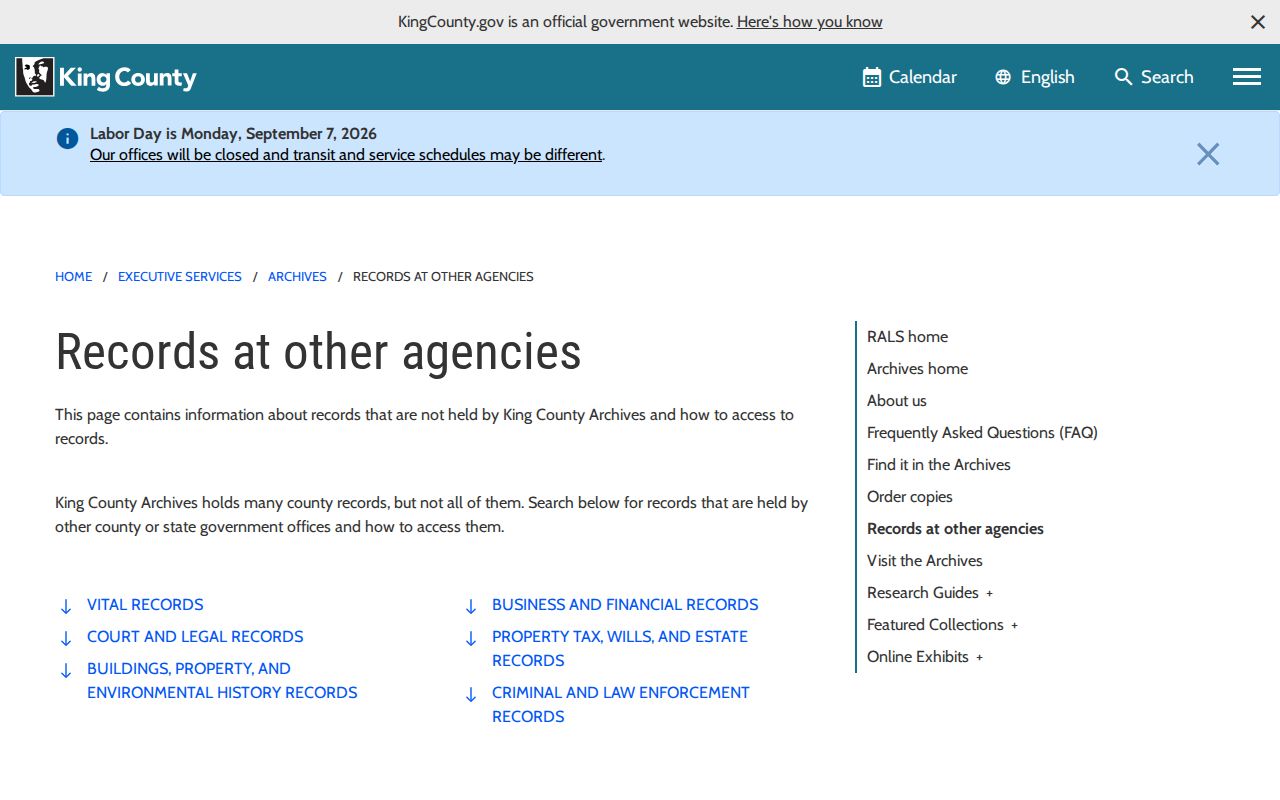
Take the failed online query, full names, a five-year range, parcel, and legal description to staff. That evidence is far more useful than the street address alone.
Bellevue Property Cards Add Detail
Puget Sound Regional Archives real-property cards cover 1937-1972 and can contain an assessment, photograph, construction date, building sketch, parcel number, ownership, and excise references. Limited tax-assessment rolls extend back into the 19th century for selected years. These records help date a structure and connect an old physical footprint to a later parcel chain.
The cards are not an address-first tool. Obtain the parcel and legal description before requesting one. A card may identify an owner and building facts, but it does not list every person who occupied the site. Compare it with a directory, census, or dated newspaper item before naming previous residents.
Archive tip. Ask with the parcel, legal description, and five-year window so staff can select the right property-card or microfilm series.
Bellevue Permits Date Changes
Bellevue Development Services records can add construction and alteration dates to the address history. The public permit search exposes a keyword field and category filter. A result may identify an applicant, owner, contractor, designer, project address, type, or status, depending on the record. Those names show project involvement, not residence.
For older plans, land-use records, clearing and grading material, or a complete file not shown online, use the Development Services records request route. Email and phone are documented alternatives, and public access remains subject to exemptions or redaction. State the address, parcel, project type, department, and date range in a narrow request. Utility customer data is not a household directory and should not be used as a substitute.
Bellevue Annexations Rename the Trail
Bellevue incorporated in 1953, but the modern boundary arrived in stages. Crossroads joined in 1964, Lake Hills in 1969, Factoria in 1993, Coal Creek in 2009, and Eastgate/Tamara Hill, Horizon View, and Hilltop in 2012. Before annexation, county records and regional directories may use a community or postal label even when the property is now firmly within Bellevue.
The 2012 annexations alone added more than 5,400 residents, about 1,850 residences, and 700 acres. That shift explains why a current Bellevue permit trail may stop while county deeds continue. Preserve three labels in research notes: the modern street address, postal city and ZIP, and the historic community or annexation name. A mismatch is evidence to interpret, not a reason to discard the record.
| Modern key | Current street address and parcel ID |
|---|---|
| Land key | Plat, lot, block, unit, or legal description |
| Historic key | Community, postal label, and annexation status at the time |
Build Bellevue Past Households
Deeds identify title parties, not all prior occupants. Regional city directories, reverse address sections, public census schedules, newspapers, probate, and cemetery collections supply the household layer. Verified Bellevue-area directory traces include 1964-65, 1966, 1972, and 1982 editions. Coverage changes by volume, so confirm the title before drawing a gap.
The household flow is simple: current address → historical label → directory entry → nearest public census → newspaper or probate evidence. Copy the complete directory line with initials, spouse notation, address, business clue, edition, and page. Then compare the closest census year under the 72-year release rule. A move, changed surname, unlisted number, death, or a volume's boundary can all explain why a name disappears.
The collections and entry-reading method are covered in the Bellevue city directory page. Use that shelf detail rather than assuming every regional year includes the same streets.
Bellevue Previous Residents in Print
Bellevue Library microfilm offers a dated bridge when directories skip years. Bellevue American runs from March 7, 1935 through August 14, 1976. Daily Journal-American covers August 17, 1976 through November 15, 1996 with listed gaps. Eastside Journal continues from November 16, 1996 through 2003 and has a February 2001 gap. Notices, obituaries, sales, and local reports may place a person or business at an address.
KCLS accepts obituary-reference requests for communities it serves, searches the death date plus ten days, and says most responses take about 14 working days. An obituary was not legally required. A failed search should record the newspaper and date gap, then move to another paper, funeral-home notice, cemetery collection, or probate file. The Eastside Genealogical Society's 1854-1917 probate index can supply a name and case number for the underlying King County file.
Limits on Bellevue Previous Residents
Dates and record roles control the conclusion. An assessor owner may use a different mailing address. A deed can name a trust or estate. A permit contact may never have lived at the site. A directory occupant need not hold title. Write “named as grantee,” “listed at the address,” or “shown as applicant” instead of merging those roles into one unsupported claim.
Maps and Sanborn fire-insurance sheets may help compare streets and building footprints, but the reviewed official sources did not establish exact Bellevue sheet years. Verify coverage with a library or map custodian before citing a date. Likewise, missing material usually reflects indexing, custody, transfer, privacy, or a microfilm gap, not proof that no person or transaction existed.
Lawful use. Research Bellevue previous residents for family history, property history, or personal curiosity. Never use the findings to track, harass, intimidate, or harm a living person.