
Bellevue City Directory Holdings
No single official Bellevue city directory runs without a break from the town's early years to the present. Publishers treated the Eastside as a changing regional market. A volume may group Bellevue with Kirkland and Redmond or list nearby communities in its coverage note. The table separates editions that research has verified from broader collections whose Bellevue coverage must be checked volume by volume.
| Collection | Years | Where Held | Access |
|---|---|---|---|
| Bellevue-Kirkland-Redmond editions | 1964-65, 1966, 1972, 1982 verified | Regional library catalogs and local collections | Confirm each title and shelf copy |
| Seattle Polk directories | 1889-1996, with gaps | Seattle Public Library, UW, regional archives | Print holdings; suburb coverage varies |
| Reverse address directories | Reverse listings from 1928; Cole runs from 1969 | Seattle Public Library and regional libraries | Use only when the edition includes Bellevue |
| R.L. Polk Seattle index | 1891-1893 | Washington State Archives Digital Archives | Free online name index |
| Local newspaper film | 1935-2003 across three Bellevue-area titles | Bellevue Library | Microfilm reader; gaps are listed |
The verified dates are anchors, not a promise that every address appears. Bellevue incorporated in 1953, and both postal labels and city limits changed as nearby areas were annexed. Search catalog notes for Eastgate, Lake Hills, Beaux Arts Village, Clyde Hill, Hunts Point, Medina, Mercer Island, Kirkland, and Redmond when the obvious Bellevue title fails.
Bellevue Directories Cross City Lines
The strongest local editions mirror Bellevue's growth. The 1964-65 and 1966 Bellevue-Kirkland volumes cover a suburban area rather than one civic boundary. A 1972 catalog trace expands the regional frame to Bellevue, Kirkland, and Redmond, with community names such as Eastgate and Lake Hills important to the search. The 1982 edition offers a later checkpoint for a household, street, or business.
Regional naming is useful evidence. It is also a warning. A printed “Bellevue” can mean a mailing community, while permits and other municipal files depend on whether the parcel was inside the city at that date. Crossroads joined Bellevue in 1964, Lake Hills in 1969, Factoria in 1993, Coal Creek in 2009, and several Eastgate-area communities in 2012. Keep the edition title, year, community label, and exact address together.
| 1953 | Bellevue incorporates; older local research stays rooted in King County records. |
|---|---|
| 1964-66 | Verified Bellevue-Kirkland directory editions mark the mid-century suburban period. |
| 1972 | A verified regional edition joins Bellevue, Kirkland, and Redmond. |
| 1982 | A later verified directory gives another address and household checkpoint. |
Decode a Bellevue Directory Entry
A printed line must be read with that volume's front matter. A normal alphabetical entry can include the listed person's name, a spouse in parentheses, a street address, and an occupation or business tie. Some editions mark a widow or widower, a boarder or roomer, or an ownership status. A reverse entry begins with the address and points back to an occupant or telephone listing.
| Name | Preserve initials, spelling, and surname order exactly as printed. |
|---|---|
| Spouse or status | Parentheses or a widow notation may connect another family name. |
| Address | Copy the number, street, unit, city label, and any residence mark. |
| Work or business | Record the wording as an identity clue, not as proof of an address. |
| Source detail | Save the volume title, year, page, edition, and key used. |
The 1968 Bellevue-Kirkland metadata sample for “Crossroads Ice Rink (Hans Johnsen), 1 Crossroads Shopping Center, Bellevue” shows why source detail matters. It preserves a person or business name, place, city, and year, but not a full residential line. The scanned page and abbreviation key still need inspection before adding facts the metadata does not show.
- Criss-cross directory
- A later directory arranged by street address or phone number rather than surname.
- Householder index
- A listing centered on the person associated with a household address.
- Abbreviation key
- The edition's own legend for shortened words and status marks. Use it instead of guessing.
Search Bellevue Directory Scans
Digital access is split among institutions. The Washington State Archives Polk collection provides a free indexed transcription for Seattle in 1891-1893. It is not a complete Bellevue run, but surname variants and regional migration can still make it useful. Seattle Public Library supplies a broader genealogy and directory route, while exact Eastside coverage must be checked against the title and year.
The State Archives collection page shows what a well-described digital directory set looks like.
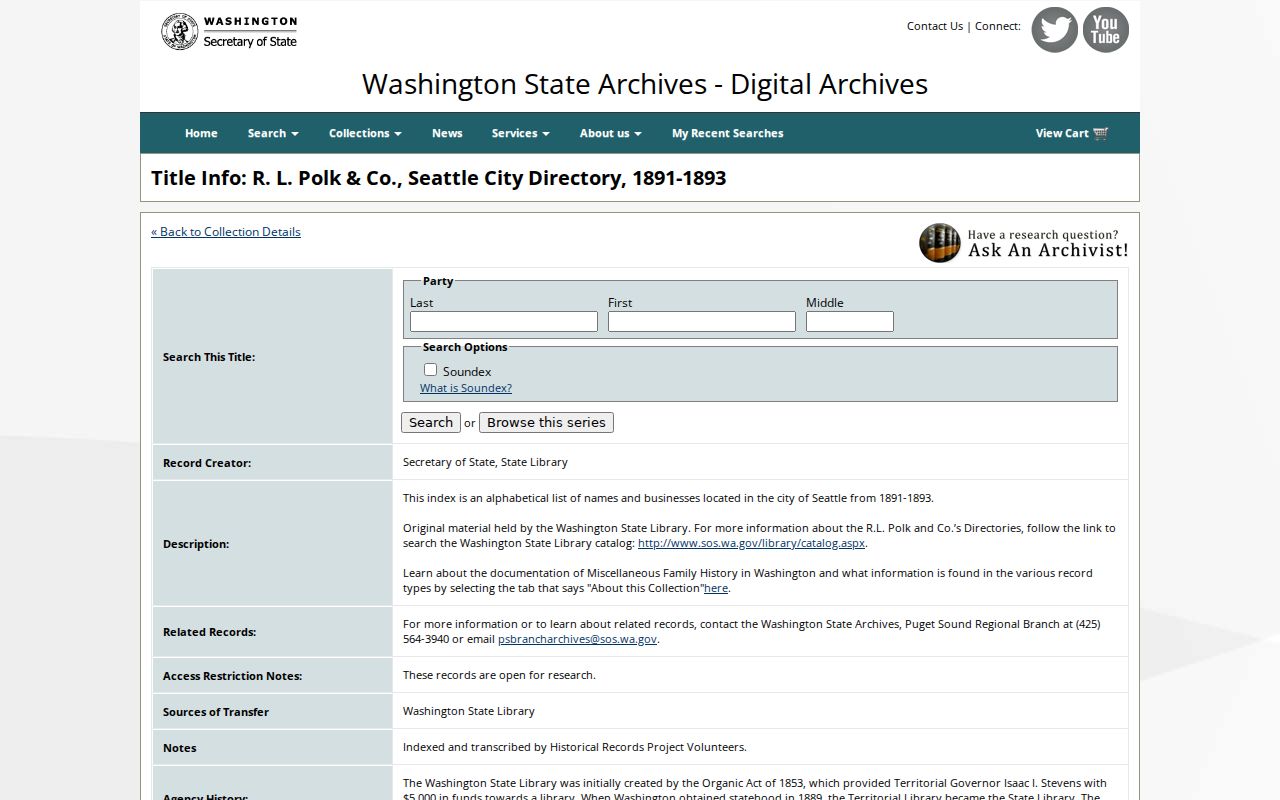
Read the collection scope before searching. A hit in a Seattle volume can support a regional family trail, but it should not be recast as a Bellevue residence without another dated source.
Bellevue Library Research Shelf
Bellevue Library at 1111 110th Avenue NE is the main local handoff when a city directory is not fully online. Its facilities include a microfilm and microfiche reader, government documents, and the Eastside Genealogical Society Library. The EGS collection holds regional histories and genealogies, some marriage and cemetery records, passenger and immigrant lists, indexes, and about 30 periodical titles. Volunteers offer scheduled research help, and library staff assist with Ancestry Library Edition for in-library use.
The Bellevue Library location page confirms the local genealogy collection and reader equipment.
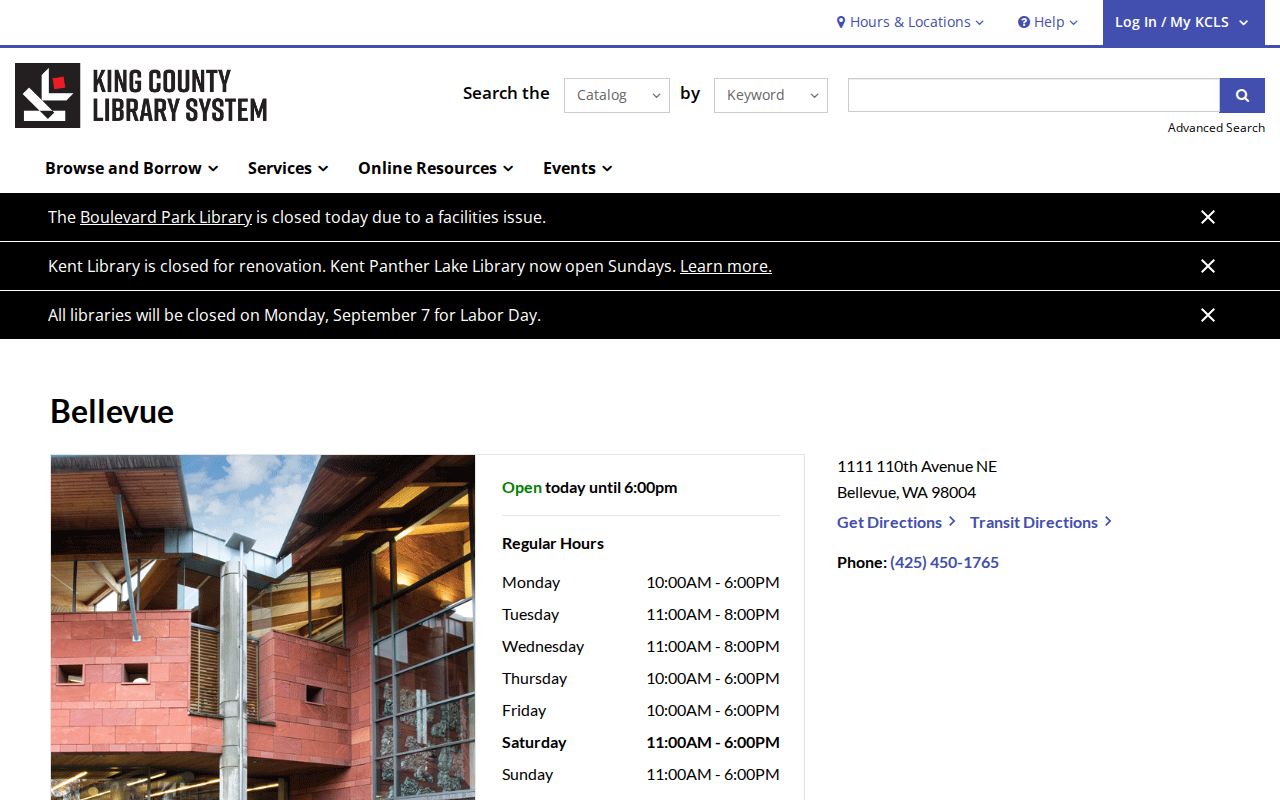
Before visiting, ask whether the exact year and regional title are held. Give staff the surname, address, community name, and a narrow date range. That is more useful than asking for every Bellevue directory.
Bellevue Names Between Directory Years
Local newspaper film can explain a move, marriage, death, business opening, or address change between printed editions. Bellevue Library holds the Bellevue American from March 7, 1935 through August 14, 1976. Daily Journal-American follows from August 17, 1976 through November 15, 1996, with listed gaps. Eastside Journal continues from November 16, 1996 through 2003 and has a February 2001 gap. The Seattle Times run at Bellevue spans 1960-2018, with a July 1963 gap.
KCLS also accepts an obituary-reference request for a person from a community it serves. Staff search the death date plus ten days, and most replies take about 14 working days. An obituary was never required, so no result is not proof that the person was absent. Log the exact paper and missing date, then try another library, probate material, or a funeral-home notice.
Use the directory year to narrow the film search. A business advertisement may confirm that an abbreviated work clue referred to the right firm. A marriage announcement can explain a surname change between editions. A death notice may connect the listed address with relatives and a probate search, while a sale notice can show when a shop or household left a place. Save the newspaper title, issue date, page, and exact wording. If the needed date falls in a listed gap, ask Seattle Public Library or another regional collection about the same title rather than treating the missing reel as a negative result.
These sources also help distinguish neighborhoods that changed labels. Crossroads, Lake Hills, Factoria, BelRed, Wilburton, Newport, and Phantom Lake reflect different periods of Bellevue growth. Search both the printed neighborhood term and the formal street address.
Bellevue Records Beyond Directories
Bellevue Historical Society adds maps, photographs, advertisements, books, signs, objects, and other place-based evidence. Its PastPerfect catalog is a lead, not a complete name index. The collection works best after a city directory has supplied a place, business, or street term that can be tested against local images and subject files.
A family-history search can also use the EGS publication Index of Probate Court Records 1854-1917. A name and case number provide a bridge to the underlying King County court material. Washington State Archives collections add marriage records, cemetery entries, naturalization files, and real-property cards, though access and dates differ by collection.
The Historical Society collection highlights show the range of Bellevue material.
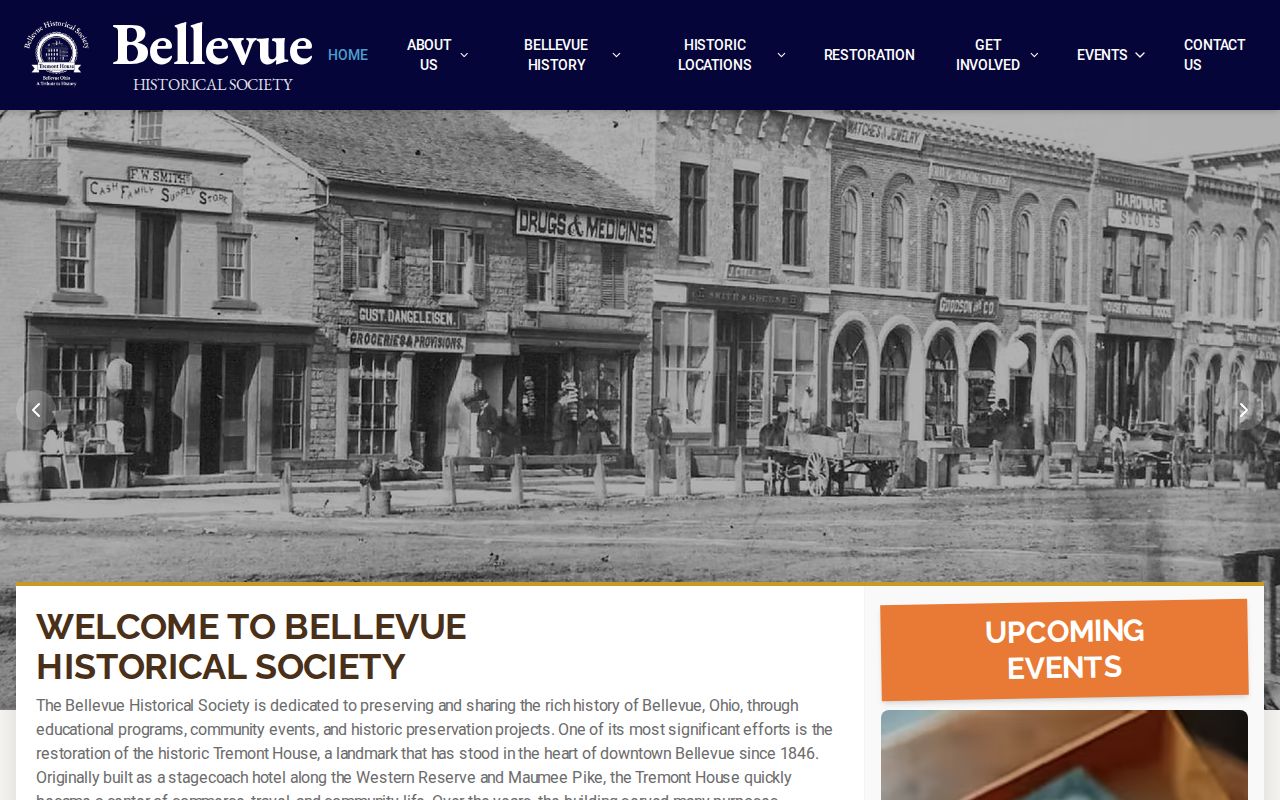
Use a directory line to frame a narrow request, such as a named shop, family, neighborhood, or dated address.
Trace Bellevue Families by Directory
City directories fill annual or irregular gaps between census snapshots. They can show that a surname changed form, an address shifted, or a spouse appeared in the listing. They cannot prove why a name vanished. The person may have moved, died, chosen an unlisted number, been recorded under a spouse or business, or fallen outside that edition's geographic reach.
- Choose a known name, address, telephone number, and narrow year. Search the alphabetical pages first.
- Copy the whole printed line, page, edition, and key. Preserve initials, spouse text, work clue, and unit number.
- Check adjacent editions in both directions. Test name variants and the reverse section where one exists.
- Pair the directory year with the nearest public federal census, then compare marriage, newspaper, probate, or deed evidence.
- Track the address through its historical community and annexation date before treating a missing line as a move.
For present-day address-keyed evidence, use the Bellevue street directory workflow rather than extending a printed directory claim beyond its date. Each finding should retain its source year. That one habit keeps people with the same name from being merged and keeps a postal Bellevue label from being mistaken for the city boundary.